
The Evening Athena Hogan Did Not Come Home

Updated: Aug 7

On the afternoon of October 1, 1986, Athena Marie “Tina” Hogan left her home in Lawton, Oklahoma, carrying chocolate candy she had sold for a school fundraiser.
Athena was a fifth-grader at Robert E. Lee Elementary School, a small neighborhood school with only 136 students. She lived in the Mission Village area with her mother, Cindy Ann Hogan, and her grandparents, Harry and Julia Hogan. According to her family, she set out at approximately 4:30 that Wednesday afternoon to deliver candy to people who had already placed their orders. It should have been a short trip through a familiar neighborhood.
By 7:30, Athena had not returned, and her family began looking for her. Her grandmother searched the area, but Athena was nowhere along the route she was expected to take. The family continued searching into the evening before reporting her missing at approximately 10:15 p.m.
By then, police had already been called to Northwest Rogers Lane.
A little after 9 p.m., a passing motorist had seen something in the grass near the north shoulder of the road, approximately 250 feet west of Northwest 82nd Street. What he found was Athena.
In the hours between leaving home and being found several miles away, a child walking through her own neighborhood had disappeared. The investigation that followed would produce hundreds of interviews, two arrests, disputed forensic evidence and a murder trial.
It would not establish who killed her.
Athena’s Route Through Mission Village
Athena left home on foot, wearing blue shorts, a pink top and tennis shoes. The original missing-person report recorded 4 p.m. as the time associated with her departure, while her family’s account in contemporary newspaper coverage placed it closer to 4:30.
Investigators spent the following day attempting to reconstruct where she had gone. Twenty-five officers moved through Mission Village, interviewing residents and tracing the route Athena may have taken as she delivered the candy. Police eventually said they had spoken with more than 300 people in the immediate neighborhood. The timeline they developed was not entirely consistent.
In the first days after Athena’s death, Assistant Police Chief Jack Partin said investigators had confirmed that she was near Northwest Fourth Street and Glendale at approximately 7:30 p.m. Several residents reported seeing her as she made deliveries, and police collected descriptions of vehicles observed in the area, but later testimony complicated that account.
Debbie Stoddard reported seeing Athena at approximately 6:50 p.m., but detectives said she had been uncertain about the identification and that her description of the girl’s clothing differed from the description supplied by Athena’s aunt. Police therefore did not accept Stoddard’s report as a confirmed sighting.
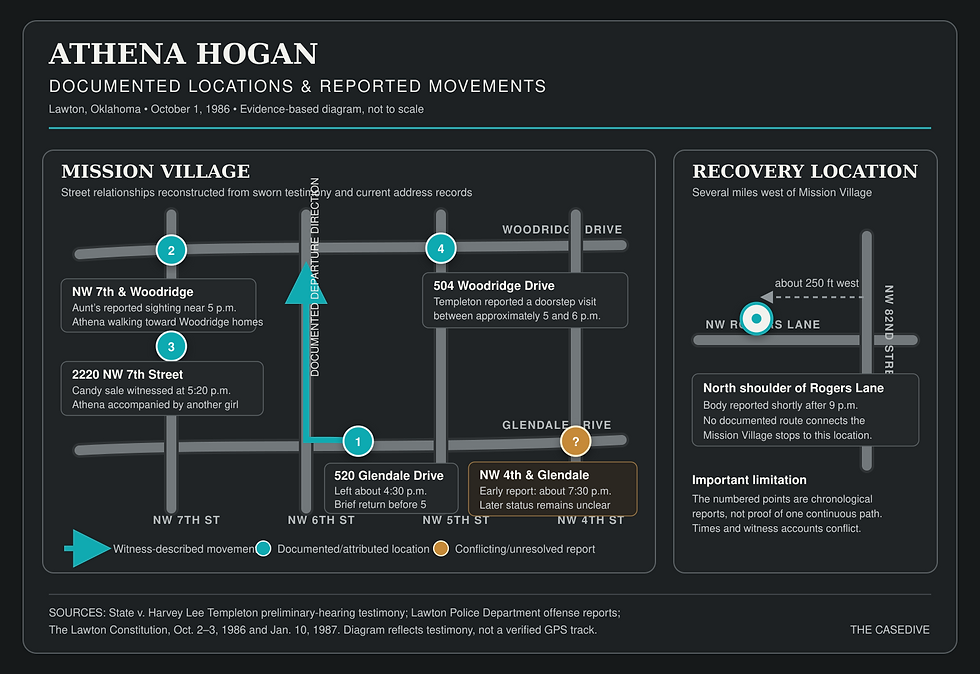
By the January 1987 preliminary hearing, investigators described Harvey Lee Templeton as the last known person to have seen Athena. Templeton lived at 504 Woodridge Drive in Mission Village, and his stepdaughter was one of Athena’s friends. He told police that Athena came to his door sometime between 5 and 6 p.m. to sell candy.
Templeton said he did not purchase any because he had already bought candy from other children and could not afford more. According to his account, Athena remained at the doorway and then continued on her way.
That left a substantial portion of the evening unexplained. It also created an unresolved conflict between the early statement that Athena had been seen around 7:30 and the later description of Templeton as the last person known to have seen her alive.
What Robert Taylor Found on Rogers Lane
Robert A. Taylor was driving near Northwest 82nd Street and Rogers Lane when he saw what he initially believed might be a person or a doll beside the road.
Taylor later testified that he had gone to the area to drink beer, listen to music and watch military flares being fired at Fort Sill. At Templeton’s trial, Lt. Richard Laughlin confirmed that his unit had been firing flares from dusk until around midnight approximately two miles northwest of the location. The lights would have been visible for miles.
After looking more closely, Taylor realized he had found a child.
He stopped another motorist, Pamela Condit, and asked her to serve as a witness. Condit remembered Taylor saying there was a dead girl, dog or body down the road, although she could not recall his exact wording. Taylor asked her to notice the time, which she placed at 9:05 p.m., and she followed him to his mother’s home.
Police arrived shortly afterward. Officer Richard Braly found Athena lying just inside the grass on the north side of Rogers Lane and checked for signs of life. Finding none, officers secured the area while detectives and crime-scene personnel were summoned.
Athena had marks around her wrists indicating that she had been bound. A washrag had been placed in her mouth, and the medical examiner determined that she died from suffocation after the cloth became lodged in her throat. Investigators estimated that she had died between approximately 7:30 and 9:30 p.m.
Athena was wearing her pink top and socks, but her shorts, shoes and the remainder of her clothing were missing. Although early reports raised the possibility of sexual assault, subsequent medical testing found no evidence that one had occurred.
Police believed Athena had died somewhere other than the roadside. Her body had been left several miles from Mission Village, transforming the effort to reconstruct her candy-delivery route into a search for the place where she had been held and killed.
An Arrest Built Around a Footprint
Taylor had reported the discovery, remained at the scene and permitted police to search his car. Within two days, however, investigators arrested him for Athena’s murder.
The arrest centered largely on what police believed was a child’s footprint on one of the car’s windows. According to Taylor’s later legal claim against the City of Lawton, he was told that Assistant Police Chief Jack Partin had examined the impression and identified it as Athena’s.
Partin gave a different account when he testified at Templeton’s trial. He said he had not been able to identify the footprint as Athena’s and had advised both police and prosecutors not to make an arrest based upon it.
Taylor was arrested on October 3. First-degree murder charges were filed on October 6, but the case against him collapsed when the Oklahoma State Bureau of Investigation determined that the footprint was not Athena’s.
The charges were dismissed almost immediately.
Investigators later testified that other evidence also failed to connect Taylor to Athena. Hair and fibers recovered during the investigation were not consistent with his samples, and detectives said they eventually eliminated him as a suspect. Capt. Andy Forguson acknowledged during the 1987 trial that police had mishandled that portion of the investigation.
Taylor subsequently sought nearly $1 million from the city, alleging false arrest, malicious prosecution, slander and emotional distress. He claimed that police had towed and searched his car, retained property and damaged his reputation so severely that he had been forced to look for employment outside Oklahoma.
In August 1987, the charges were dismissed with prejudice, preventing them from being filed against him again. Taylor filed a civil lawsuit against Lawton that same month, although he voluntarily dismissed it in May 1988.
By the time his name was formally cleared in court, the investigation had already moved toward another home in Mission Village.
The Carpet Inside 504 Woodridge
On October 24, detectives Larry Mahamed and Don Belcher began going door to door in Athena’s neighborhood, examining carpets and collecting samples. Their search had been directed by OSBI criminalist Ann Reed. Fibers recovered from Athena’s clothing suggested that investigators should look for an older, badly worn shag carpet containing maroon, red and orange fibers.
When the detectives reached 504 Woodridge, Harvey Templeton answered the door and allowed them inside. While Mahamed knelt to collect samples, Templeton volunteered that Athena had visited his home on the day she died.
Templeton later gave a formal statement on October 31 and provided samples of his head and pubic hair. He told investigators that Athena had come to the door at approximately 5:30 p.m. but had never entered the house.
The laboratory findings became the center of the case against him.
Reed testified that 20 fibers recovered from Athena’s blouse and eight from her socks were consistent in color, texture and condition with carpet covering much of the Templeton home. One additional fiber from Athena’s blouse was consistent with a different patch of carpet in the hallway. Three fibers taken from the socks were not consistent with the carpet. The carpet was at least a decade old and heavily damaged. Reed described its combination of fibers as unusual.
Head and pubic hairs recovered from Athena’s clothing and the sheet used to transport her body were also described as consistent with Templeton’s samples. Reed considered characteristics of both his head and pubic hair unusual. A hair vacuumed from the rear floorboard of a Dodge Charger that Templeton had traded was consistent with Athena’s known hair sample.
Those findings sounded powerful when reduced to the word “match,” but Reed placed an important limitation on them during her testimony. Microscopic hair comparison could be used to exclude a person, she explained, but it could not positively identify the individual from whom a hair originated. She could say that hairs were consistent with one another, not that they definitively came from Athena or Templeton.
The same question of timing surrounded the fibers. Templeton’s stepdaughter was Athena’s friend, and Athena had reportedly visited the home before October 1. Even if the fibers originated there, the evidence could not establish when or under what circumstances they became attached to her clothing.
Police arrested Templeton on November 8 and charged him with Athena’s kidnapping and murder.
A “Very Close Call”
At Templeton’s preliminary hearing in January 1987, Special District Judge Allen McCall described the decision to send the case to trial as a “very close call.” The state argued that Templeton was the last known person to see Athena, that fibers on her clothing were consistent with carpets in his home, and that hairs associated with her body were consistent with his samples. The defense argued that none of the evidence positively identified Templeton and that Athena’s friendship with his stepdaughter offered an innocent explanation for material from the home.
The burden at that stage was probable cause, not proof beyond a reasonable doubt. McCall ruled that the evidence was sufficient for a jury to hear the case.
Templeton remained in the Comanche County Jail until his trial began the following July. Prosecutors pursued alternative theories of first-degree murder and murder committed during a kidnapping, and Assistant District Attorney Roy Calvert announced that the state would seek the death penalty.
At trial, the state’s case rested largely on the hairs, carpet fibers, Templeton’s contact with Athena that afternoon and the proximity of his home to her route. Templeton testified in his own defense.
He said he had injured his hand while working as a city trash collector two days before Athena’s death and had been sent home on light duty. His wife and children were visiting North Carolina, leaving him alone at the house.
According to Templeton, he watched television until sometime after Athena came to the door. He later sat outside drinking tea and watched people arrive for a 7 p.m. prayer service at Mission Village Baptist Church. Sometime afterward, he gathered bags of household trash, drove to a 7-Eleven near Gore Boulevard and Fort Sill Boulevard, placed the bags in a dumpster and bought cigarettes.
Templeton denied abducting or killing Athena.
Prosecutors also presented testimony about a psychological profile requested from the U.S. Department of Justice. Capt. Forguson described the suspected killer as an adult male acting out a sadistic fantasy against a victim of opportunity and said he believed Templeton generally fit the profile. The defense challenged both that conclusion and the assumptions behind it.
The state introduced testimony concerning tennis-shoe impressions near Athena’s body and shoes found in the Templeton home. During closing arguments, the defense emphasized that the shoes were reportedly a women’s size 5 belonging to Templeton’s wife, while Templeton wore approximately a size 7½. The shoes themselves were not introduced into evidence.
The competing cases eventually came down to what the forensic findings could prove.
Calvert asked jurors to consider how unusual the carpets and Templeton’s hair appeared to the OSBI examiners. The defense reminded them that “consistent with” did not mean positively identified and argued that the evidence left too much room for an innocent transfer.
On July 21, 1987, six men and six women retired to consider the charge. Their first ballot was reportedly 11 in favor of acquittal and one juror uncertain. After reviewing the evidence for less than an hour, the jury returned a unanimous verdict.
Harvey Lee Templeton was found not guilty.
He had spent more than eight months in jail awaiting the outcome.
The Other Violence Surrounding Athena’s Family
The investigation unfolded against another tragedy that had already changed Athena’s home.
Approximately six months before Athena was killed, her mother, Cindy, had been severely beaten outside neighboring residences on Glendale. Cindy suffered brain damage, lapsed into a coma for two weeks and experienced strokes that left one side of her body paralyzed for months. Contemporary reports said she struggled to walk and speak afterward.
A man was charged in connection with that assault, but the case was repeatedly postponed because Cindy’s injuries prevented her from testifying. When she was eventually able to appear at a preliminary hearing in August 1987, she could not identify the person who had attacked her, and the charge was dismissed.
During the hearing against Templeton, defense attorneys asked whether police had considered a connection between the assault on Cindy and Athena’s death. A former detective testified that the possibility had been investigated, although he could not identify who handled that inquiry or provide a suspect’s name.
Nothing in the available material establishes that the two crimes were connected. Still, the question was part of the original investigation, and the violence against Cindy helps explain the circumstances inside Athena’s household when she disappeared. Her mother was alive, but she had survived a devastating attack and was still living with its consequences when her daughter was killed.
An Investigation Without a Conviction
The day after Templeton’s acquittal, Lawton Police Chief Robert Gillian said investigators were reviewing every piece of information again, including testimony that emerged during the trial.
“You never close a murder investigation and won’t give up,” Gillian told the Lawton Constitution.
Police once again asked residents to report anything they remembered, even if it seemed unimportant. A Crime Stoppers reward remained available, but authorities acknowledged that no genuinely new information had surfaced for some time. The available records do not identify another arrest or prosecution.
Robert Taylor was arrested after reporting Athena’s body, but the footprint that drove the case against him was not hers, and police later said forensic evidence excluded him. Harvey Templeton acknowledged seeing Athena that afternoon, and hairs and fibers were found that investigators considered consistent with samples connected to him and his home. Those comparisons could not positively identify their source, however, and a jury acquitted him after deliberating for less than an hour.
The verdict answered whether the state had proven its case against Templeton. It did not answer what happened to Athena after she continued along her route.
That unanswered stretch of time remains at the center of her story.
Athena left home carrying candy for people in her neighborhood. She was seen walking through Mission Village, stopping at doors and completing an ordinary task for her school. Within hours, she had been taken several miles from the streets she knew and left beside Rogers Lane.
Investigators traced her route, searched homes, examined cars, compared hairs and carpet fibers, built cases against two different men and took one of those cases to trial. Nearly forty years later, the route still ends before the person responsible is found.
Athena was ten years old.
Her murder remains unsolved.
Source Note
This article was developed from original case materials submitted to The CaseDive by Amber of Into the Weeds Podcast, including:
Lawton Police Department missing-person and homicide offense reports, October 1, 1986
Transcript of testimony in State of Oklahoma v. Harvey Lee Templeton, Comanche County District Court, Case No. CRF-86-587
Court’s instructions to the jury in State of Oklahoma v. Harvey Lee Templeton
The Lawton Constitution, “Athena Hogan,” October 2, 1986
The Lawton Constitution, “Girl Choked to Death on Rag, Police Say,” October 3, 1986
The Lawton Constitution, “Templeton Bound Over for Trial,” January 10, 1987
The Lawton Constitution, trial coverage published July 17–22, 1987
The Lawton Constitution, “City Police Review Hogan Case,” July 23, 1987
The Lawton Constitution, reporting on Robert Taylor’s arrest, legal claim and civil lawsuit, 1986–1988
The Lawton Constitution, reporting on the assault against Cindy Ann Hogan and the subsequent court proceedings, 1986–1987
The complete Athena Hogan CaseDive file contains the available timeline, original newspaper coverage and supporting documents.
Into the Weeds has also produced a multipart examination of the Athena Hogan case and trial transcripts, available through their podcast channel.
Help Expand This Case File
If you have newspaper coverage, public records, photographs or other documented information related to Athena Hogan’s case, you can submit it for review and possible inclusion in the CaseDive file.
Have a question or thought about Athena's case? You’re welcome to leave a respectful comment below.


Comments